
2027
AI Marketing
Automation
Playbook
A practical guide to capturing the full value
of AI in marketing, based on proprietary data
and best practices from leading enterprises
To the teams shaping
the future of marketing

Dear reader,
Marketing is at an inflection point. Over the past decade, we have seen continuous evolution in channels, formats, and measurement. But the underlying way marketing operates has remained largely unchanged. Campaigns are planned a while in advance, assets are produced upfront (often with an agency partner), and performance is analyzed after the fact. Even as tools have improved, the fundamental model has stayed the same.
Artificial intelligence is now challenging that model.
In conversations with marketing leaders across industries, one theme consistently emerges. There is strong interest in AI, and in many cases, early adoption is already underway. Teams are experimenting with generative tools, increasing content output, and exploring new ways of working. At the same time, there is a shared sense of uncertainty around what meaningful adoption should look like beyond these initial steps.
At Uplane, we have learned from working with some of the world's leading enterprises on this adoption that the true impact of AI does not come from doing more of the same, faster. It comes from changing how marketing operates at its core.
At its best, marketing has always been a system of continuous learning. Insights lead to ideas, ideas are tested in market, and results inform the next iteration. However, in most organizations, this loop is slow, fragmented, and difficult & expensive to scale. AI now provides the opportunity to run this system in a fundamentally different way, with greater speed, consistency, and precision.
This playbook is an attempt to make that shift more tangible and provide you with an actionable guide for this transition in 2027.
It brings together observations from working with organizations at different stages of AI adoption, proprietary performance data gathered during our work with leading enterprises, as well as patterns that consistently emerge across industries. Our goal is to provide a practical perspective on what it takes to move from isolated production and experimentation to a more systematic, scalable approach to marketing.
The transition will not happen overnight. It requires not only new technologies, but also changes in processes, roles, and ways of thinking. However, the direction is clear. Marketing is moving from a campaign-driven execution function to a system-driven strategic discipline.
We hope this playbook helps you navigate that transition.

Julius Korfgen
CEO, Uplane

Contents

San Francisco, USA
In the AI era, marketing advantage shifts from budget and ideas to execution speed and intelligence.
At a glance
Driving marketing performance and efficiency with AI
Dual impact of AI on marketing
Over the past three years, artificial intelligence has rapidly entered the marketing function. Most organizations have already experimented with generative tools, scaled content production, and introduced elements of automation into their workflows. On the surface, this suggests meaningful progress.
However, when looking at performance outcomes, the picture is more nuanced: Across enterprise marketing teams, content output has increased significantly, often by a factor of four to twelve. Yet improvements in core metrics such as ROAS, conversion rates or cost efficiency have remained comparatively modest. In many cases, gains are limited to incremental improvements in the range of 5-10%.
This gap points to a structural issue. AI is not primarily a content multiplier but rather an enabler of automated systems. At its core, effective marketing has always followed a simple logic: generate insights, translate them into asset variants, test these in market, and learn from outcomes. We describe this cycle as a marketing performance flywheel. When operating effectively, this flywheel compounds performance through ongoing optimization over time. In practice, however, most organizations do not run a true flywheel, but rather disconnected steps.
AI changes this dynamic. It enables organizations to operate the flywheel continuously, at significantly higher speed and scale, and increased cost efficiency. The competitive advantage is therefore shifting away from campaign execution toward systematic learning velocity.
Organizations that successfully make this transition will not only improve performance but fundamentally change how quickly they can adapt and compete.


“What matters is no longer how many campaigns you run, but how quickly your system can generate, evaluate, and scale what works.”

The Marketing
Performance
Flywheel
At its core, marketing effectiveness is driven by a repeatable cycle. This cycle can be structured into four stages:
- Market intelligence and data analysis
- Asset production and personalization
- Testing and deployment
- Learning and optimization
In an ideal state, these stages form a continuous loop. Insights inform new asset variants, variants are tested, results generate learnings, and those learnings feed directly into the next iteration. Over time, this creates a compounding effect, where each cycle improves the next.
Historically, however, this flywheel has rarely operated in a continuous manner. Instead, most organizations execute these steps sequentially and in isolation. Insights are generated but not systematically translated into new variants at scale. Testing is limited in frequency and scope. Learnings are documented but not reused across campaigns and only collected post-campaign when it's too late for in-flight optimization. Data remains fragmented across systems, limiting visibility and slowing decision-making. As a result, for most large organizations, this flywheel is effectively broken. Each campaign starts from a partial reset, and the compounding effect is limited.
Marketing performance flywheel
With the rise of AI, we do not want to introduce a new model of marketing but rather enable the original flywheel to function as intended. By accelerating each stage of the flywheel, AI allows organizations to collect and analyze market intelligence and 1P customer data in real time, generate more relevant variants fast and cost-efficient, test them at scale, extract insights faster, and systematically reuse those insights on the spot across campaigns and channels. This transforms the flywheel from a slow, manual process into a continuous, self-optimizing system.
Facts & Figures:
of campaign learnings are being re-used in organizations with fragmented workflows
variation in testing velocity between companies in the same industry
of campaigns still launch without applying prior learnings in a structured way
Case Example: From Fragmentation to Continuity in CPG
A subscription-based consumer company analyzed six months of paid social campaigns and found that while insights were regularly documented, they were rarely applied in subsequent campaigns.
After introducing structured test loops and standardized learning reuse with Uplane, the company increased testing frequency by 4x and reduced the time required to identify high-performing creatives by >60%. Cost per acquisition decreased by ~18% over the following quarter.
The primary driver was not improved creative quality, but the consistent application of learnings across cycles.
Key takeaway:
The effectiveness of marketing is determined less by individual campaign quality than by the speed and consistency with which learnings compound across cycles.
From Campaign
Execution to
Marketing System
Design
Despite the importance of iteration, most organizations continue to structure marketing around campaigns. Campaigns, even always-on, are inherently static. They are defined upfront, executed over a fixed period, and in most cases only optimized retrospectively.
This model creates structural inefficiencies. Learning cycles are slow, insights decay between campaigns, and optimization often happens too late to influence outcomes meaningfully.
In contrast, a system-based approach treats marketing as a continuous process. Instead of launching campaigns, organizations operate systems that generate new variants, test them in real time, and adapt variants and budget allocation based on live performance signals.
The distinction is subtle but fundamental. Campaigns optimize outcomes within a fixed timeframe and often even siloed within individual channels, while systems optimize the process that generates those outcomes, acting as a cross-silo execution layer.
Organizations that have made this transition show consistent patterns:
- Testing becomes more frequent and less resource-intensive
- Performance stabilizes as systems converge toward high-performing variants
- The reliance on individual campaign "wins" decreases, as improvements become cumulative
Facts & Figures:
time spent for introducing new variants by campaign-based teams
new variants introduced by system-based teams
for meaningful learnings, and performance variability decreases as systems mature
Case Example: Continuous optimization in retail
A retail company implemented Uplane to transition from seasonal campaign planning to continuous optimization loops across its digital media channels.
As a result, testing frequency increased 6x, and budget allocation shifted from periodic adjustments to dynamic reallocation. Over time, performance became more stable, with fewer extreme fluctuations and more consistent efficiency gains.
Key takeaway:
The primary subject of competition in marketing is shifting from campaigns to systems.
Optimization:
The True Source
of Value
The rapid increase in content generated by AI has led many organizations to focus on volume. This is a natural first step. When production constraints disappear, it is intuitive to assume that more output will lead to better results. In practice, however, the relationship between volume and performance is far more limited than expected.
Across industries and use cases, a consistent pattern emerges. Marketing performance is highly concentrated. A small subset of variants (~10%) drives the majority of outcomes, while the long tail contributes little incremental value. Increasing the number of creatives, messages, or landing pages beyond a certain threshold does not proportionally increase performance. Instead, it introduces complexity and noise.
This changes the fundamental economics of marketing: Historically, content production was expensive, and the ability to generate high-quality assets at scale was a competitive advantage. Today, content is abundant. The constraint has shifted from production to selection. The key question is no longer how to create more variants, but how to identify the right ones quickly and reliably.
Performance concentration
In an AI-driven environment, value is created through the ability to run rapid cycles of hypothesis, testing, and learning. Each cycle generates information about what works and what does not. Over time, these insights accumulate, enabling more effective decision-making and better performance.
However, this only works if the system is designed to capture and reuse those insights. In many organizations, this is not the case. Learnings are often implicit, stored in individual teams, or lost between campaigns. As a result, each new initiative starts with limited context, and the same mistakes are repeated.
AI creates the opportunity to change this dynamic. By structuring and codifying learnings, organizations can build systems that improve over time rather than resetting with each campaign.
A second critical factor is speed. In traditional marketing models, feedback loops are slow. Campaigns are launched, results are analyzed after a defined period, and adjustments are made in the next cycle. This delay limits the ability to respond to changing conditions and reduces the total number of learning cycles that can be run.
AI significantly accelerates these loops: Variants can be generated and tested in parallel, performance signals can be captured and interpreted in near real time, and adjustments can be applied continuously rather than periodically. This increases both the frequency and the quality of learning.
Importantly, speed is not only about efficiency, but rather changes outcomes. Organizations that can run more cycles in the same amount of time are able to converge more quickly toward high-performing configurations. They also reduce the cost of experimentation, as unsuccessful variants are identified and discarded earlier.
Uplane's optimization process includes rapid iterations within days based on learnings from prior tests, and captures all relevant insights and AI intentions behind iterations to ensure learnings are being transferred.

As testing volume increases, another challenge emerges: Distinguishing meaningful signals from noise. Not every performance fluctuation reflects a true insight. Variability in data, external factors, and small sample sizes can all distort results. Without proper structures, increased testing can lead to confusion rather than clarity.
This makes signal extraction a critical capability. AI can support this by identifying patterns across large datasets, isolating statistically relevant differences, and surfacing insights that may not be immediately visible. However, this requires a combination of data quality, analytical frameworks, and system design. Organizations that succeed in this area are able to make more confident decisions, scale winning variants faster, and avoid overreacting to short-term fluctuations.
Perhaps the most important shift is the transition from isolated learnings to compounding systems. In a campaign-based model, insights are often tied to specific initiatives. Even when they are documented, they are not systematically reused. The impact of each learning is therefore limited.
In a system-based model, learnings are treated as reusable assets. They are codified, structured, and applied across campaigns, channels, and time periods. This creates a compounding effect, where each cycle builds on the previous one. Across Uplane deployments, this is one of the strongest differentiators between average and high-performing teams. While both groups generate insights, only the latter consistently reuse them at scale.
Compounding effect over time
Facts & Figures:
of creatives typically drive between 70-90% of performance
variants per test is apprx. the number of variants before experiencing diminishing marginal returns
uplift in conversion rates vs baseline for teams with structured learning systems
Case Example: E-commerce retailer shifted from volume to learning
A US direct-to-consumer retailer increased creative output in paid social campaigns by more than five times using AI tools, but saw limited performance improvement and rising customer acquisition costs.
Working together with Uplane, the company shifted to a structured testing approach with defined hypotheses and a structured optimization approach leveraging winning patterns. While producing fewer new creatives per cycle, it increased testing consistency and reuse of insights.
Within three months, conversion rates increased by 30%+ and acquisition costs declined by ~20%, driven primarily by faster learning and more effective scaling decisions.
Key takeaway:
The key advantage in AI-driven marketing lies not in producing more, but in learning faster and acting on those learnings.
Data and Technology
as the Foundation of
the Flywheel
The effectiveness of the flywheel depends fundamentally on the quality of its foundation. While much of the current discussion around AI in marketing focuses on applications and use cases, the underlying enablers are often less visible. In practice, however, they are decisive.
Two elements are particularly critical: Data and technology infrastructure. Together, they determine whether the flywheel can operate at all, how fast it can run, and how reliably it can generate meaningful outcomes.
At each stage of the flywheel, these elements play a central role. Research and analysis depend on access to relevant, structured data. Variant generation benefits from contextual inputs and historical learnings. Testing requires the ability to deploy and iterate at scale. Learning and optimization depend on consistent signal extraction and feedback loops. If any of these elements are missing or fragmented, the flywheel slows down or breaks entirely. In many organizations today, this is precisely the case.
Data is often distributed across multiple systems, including paid media platforms, CRM tools, analytics environments, and content management systems. These systems are rarely fully integrated, leading to partial visibility and inconsistent insights. At the same time, technology stacks have typically evolved incrementally, resulting in a patchwork of tools that are not designed to operate as a cohesive system.
Historically, marketing data has been used primarily for reporting. Dashboards provide visibility into past performance, enabling teams to evaluate campaigns and inform future decisions. While this remains important, it is not sufficient in an AI-driven environment. AI systems require data not as an output, but as an input. This shifts the role of data from retrospective analysis to real-time signal generation. Instead of asking what happened, organizations need to focus on what signals can be used to drive immediate decisions.
Data requirements
- Structured in a way that can be consumed by systems rather than only by humans
- Accessible in near real-time
- Consistent across channels and use cases
First-party data plays a particularly important role in this context. As access to third-party data becomes more limited, organizations increasingly rely on their own data assets to inform targeting, personalization, and optimization. When properly integrated, first-party data enables more relevant variant generation and more precise testing.
If data provides the input, technology provides the execution layer. AI-driven marketing requires infrastructure that allows systems to access data, generate variants, deploy them across channels, and continuously adapt based on performance signals. This depends on several capabilities.
First, integration is essential. AI systems need to connect to core platforms such as ad networks, CRM systems, CDPs, content management systems, and analytics tools.
Second, orchestration is required. Individual tools may perform specific functions, but value is created when these functions are coordinated.
Third, scalability matters. As testing volume increases and iteration cycles accelerate, systems must be able to handle higher levels of activity without introducing friction or delays.
Across Uplane implementations, organizations that successfully move toward automation share a common characteristic: They treat AI not as an additional tool, but as one cohesive layer embedded within their existing technology stack. Rather than replacing systems, AI connects and orchestrates them.
Despite significant investments in data and technology, many organizations struggle to realize their full potential. McKinsey & Company's State of Marketing report 2026 shows that while AI laggards realized almost no gains at all, AI leaders in marketing followed a sharply different trajectory. In the report, AI laggards name tech infrastructure and adoption and scaling as the key challenges for capturing value. This is closely aligned with what we're seeing with new Uplane clients:
A common issue for them is fragmentation. Data remains siloed across systems, and integrations are either incomplete or inconsistent. This prevents the creation of a unified view and limits the ability to generate reliable signals.
Another issue is misalignment between tools and workflows. AI capabilities are often introduced as standalone solutions, rather than being embedded into existing processes. As a result, teams are required to switch between tools, reducing efficiency and limiting adoption.
When working with clients, Uplane integrates with all existing platforms as needed, incl. CDP, CRM, ERP, DAM, and custom solutions.

It is therefore important to avoid two common misconceptions: The first is that AI-driven marketing is primarily a technology problem. The second is that technology does not matter and that success is driven purely by organizational change.
In practice, both perspectives are incomplete, because technology is a prerequisite. Without the right infrastructure, the marketing flywheel cannot operate effectively. At the same time, technology alone does not create impact. Across organizations, more than half of AI initiatives remain at the pilot stage. The primary barriers are not always technical limitations, but challenges related to workflow integration, ownership, and skills. Teams experiment with AI, but do not embed it into their daily processes. As a result, initial momentum is lost.
Successful organizations address both dimensions simultaneously. They invest in robust data and technology foundations while actively adapting their operating models, processes, and capabilities.
Facts & Figures:
outperformance vs baseline for campaigns leveraging enriched first-party data
reduction of effective learning reuse caused by fragmented data environments
of AI initiatives stalling at the pilot stage do so due to non-technical barriers
Case Example: From fragmented stack to integrated system in travel
A travel company operated with separate systems for CRM, web analytics, and paid media, with limited integration between them. While each system provided valuable insights, the lack of connectivity prevented the organization from applying these insights consistently across channels.
By integrating data sources into a unified environment and connecting core platforms to Uplane as a centralized orchestration layer, the company was able to improve audience segmentation, generate more relevant variants, and accelerate testing cycles. Over time, this enabled a more continuous operation of the marketing flywheel, with performance improvements accumulating across iterations.
Key takeaway:
Data and technology do not differentiate organizations on their own, but they determine what is possible. Without a strong foundation, the marketing flywheel cannot operate effectively. With it, organizations gain the ability to run faster, learn more, and scale improvements systematically.
The AI Marketing
Maturity Curve
As organizations adopt AI marketing, a consistent pattern emerges. Progress does not happen in a single step, but across distinct stages of maturity. Each stage is characterized by how deeply AI is integrated into workflows, how decisions are made, and how effectively the marketing performance flywheel operates. Understanding these stages is critical, as many organizations tend to overestimate their maturity. While AI tools are widely adopted, far fewer organizations have embedded them into systems that drive continuous performance improvements.
Across Uplane deployments, four levels of AI marketing maturity can be observed: Assistance, Augmentation, Automation, and Autonomy.
AI adoption progression
Level 1: Assistance AI as a tool
At this stage, AI is primarily used to support individual tasks. Typical applications include generating assets, matching landing pages or enabling personalization. The impact is immediately visible in terms of efficiency: Teams are able to produce significantly more content in less time, often increasing output by several multiples while reducing manual effort. However, the underlying marketing model remains unchanged. Campaigns are still planned manually, and testing is facilitated via the platform but run manually. The marketing performance flywheel exists, but it is not yet running at full speed, as AI accelerates isolated steps but does not connect them into a continuous system. As a result, performance improvements remain relatively modest despite increased output.
Most organizations currently operate in this stage, particularly in the early phases of AI adoption.
What it takes to move to Level 2
- Establish consistent usage across teams rather than isolated experimentation
- Introduce basic structures for prompting, asset generation, and reuse
- Build awareness of how AI can support decision-making, not just execution
Level 2: Augmentation AI as a support layer
At this stage, AI begins to influence decision-making. In addition to generating assets, AI is used to suggest variants, identify performance patterns, and provide recommendations for optimization. Teams start to rely on AI for insights, not just execution. Testing becomes more structured, and initial efforts are made to capture and reuse learnings. The marketing performance flywheel starts to take shape, as insights are more consistently translated into action. However, components of the final execution remains manual, as humans are still responsible for launching tests, approving creatives, and applying insights.
This creates a situation where decision quality improves, but scalability remains limited. The flywheel turns more effectively than before, but it does not operate continuously.
What it takes to move to Level 3
- Define repeatable workflows and standardized templates for testing and optimization
- Integrate AI into core tools such as ad platforms, CMS, CDP, and CRM
- Shift from one-off insights to structured learning systems
Level 3: Automation AI as a guided execution engine
This stage represents a fundamental shift. AI is no longer limited to supporting or informing decisions. It begins to execute defined workflows. This includes automatically generating variants, launching tests, iterating based on performance signals, and reallocating resources within predefined guardrails. The marketing performance flywheel becomes operational in a continuous manner. The cycle of variant generation, testing, and learning runs with minimal manual intervention, allowing for significantly higher speed and consistency. Human roles shift from execution to system design, oversight, and optimization.
This stage is where most of our clients are currently operating in after partnering with Uplane, and it unlocks substantial performance improvements. Organizations are able to run significantly more experiments, reduce time-to-market, and systematically reuse learnings across campaigns and channels. The compounding nature of the flywheel becomes visible, as each iteration builds on previous insights.
What it takes to move to Level 4
- Expand automation across channels and functions
- Integrate data sources into a unified system
- Build trust in AI-driven decision-making and establish governance models
Level 4: Autonomy AI as a self-optimizing system
At the most advanced stage, AI manages the marketing performance flywheel end-to-end. Systems operate autonomously, coordinating across channels, continuously optimizing creatives, targeting, and budget allocation. Human involvement shifts almost entirely toward strategic direction, brand governance, and defining constraints. Execution becomes an always-on process, with AI systems continuously generating, testing, and optimizing without requiring manual intervention.
The flywheel operates at maximum velocity, with minimal friction between stages: Insights are immediately translated into action, and performance improvements compound over time. While this stage is still emerging, early implementations indicate significant potential in terms of both efficiency and effectiveness.
What it takes to sustain this level
- Organizational alignment around AI-first operating models
- Strong governance and risk management frameworks
- Continuous monitoring and refinement of AI systems
Facts & Figures:
increase in experimentation volume as companies move from assistance to automation
average reduction in time-to-launch through workflow automation
ROAS uplift and up to 80% conversion rate improvement at higher maturity levels
Case Example: Progressing toward automation in a regulated environment
A global prescription pharmaceutical company initially worked with Uplane to adopt AI for content generation in non-promotional and disease awareness assets, increasing output and personalization while ensuring strict adherence to regulatory and medical guidelines.
In the next phase, the organization introduced AI-supported analysis to identify high-performing messaging within approved claim frameworks. However, final execution remained manual due to compliance requirements and approval processes.
To progress further, the company partnered with Uplane to implement structured workflows combining pre-approved content modules, automated variant generation and testing within defined guardrails, and integrated compliance checks prior to approval. This enabled more consistent testing while maintaining regulatory standards.
As a result, the organization significantly increased testing volume within compliant boundaries and reduced iteration cycles, and is now piloting fully autonomous asset creation and optimization approaches.
Key takeaway:
AI maturity is not defined by how many tools an organization uses, but by how much of the marketing performance flywheel operates automatically and continuously.
Measuring Flywheel
Performance
In an AI-driven marketing environment, measurement plays a fundamentally different role than in traditional campaign-based models. While outcome metrics such as return on ad spend or cost per acquisition remain important, they are no longer sufficient to capture how well the marketing system operates.
If marketing is understood as a flywheel, then performance is not only defined by results, but by how effectively the system generates, tests, and applies learnings over time.
This requires a broader measurement approach that combines outcome metrics with system-level indicators, and that reflects how value is created across the entire funnel.

"If you cannot measure the impact of AI in marketing, you cannot manage it. And if you cannot manage it, you will never capture its full potential."

A common limitation in current measurement approaches is the overreliance on marketing-specific metrics. Metrics such as click-through rates, cost per acquisition, or short-term conversion rates provide useful signals, but they often capture only a fraction of the underlying value.
As AI enables faster optimization, there is a risk of overfitting toward easily measurable, short-term outcomes. This can lead to suboptimal decisions, such as prioritizing lower-quality customers or undervaluing long-term brand effects.
Leading organizations therefore shift their focus toward business impact metrics.
Business impact metrics
- Customer lifetime value
- Contribution margin or profit per customer
- Retention and repeat purchase behavior
By linking marketing activities to these metrics, organizations can better assess the true value of their actions and avoid optimizing for vanity metrics that do not translate into sustainable growth.
In practice, this often requires connecting marketing data with downstream business data, which remains a challenge for many organizations.
A second challenge lies in the way performance is measured and optimized across channels.
Most marketing platforms provide sophisticated optimization capabilities within their own ecosystems. However, these optimizations are typically limited to channel-specific objectives. As a result, each channel is optimized in isolation, often without considering its role within the broader customer journey.
This can lead to inefficiencies and misallocation of budget. For example, lower-funnel channels may appear highly efficient because they capture demand that was created elsewhere, while upper-funnel activities may be undervalued due to their indirect impact.
To address this, organizations need to adopt a cross-channel perspective.
Cross-channel perspective
- Aggregating performance data across channels
- Understanding interactions and dependencies between touchpoints
- Making budget and optimization decisions at the system level rather than within individual platforms
AI can support this by identifying patterns across datasets and enabling more holistic optimization. However, this again depends on having the necessary data integration and measurement frameworks in place.
A third dimension is the integration of performance and brand measurement.
Traditionally, these areas have been treated separately. Performance marketing focuses on short-term conversions, while brand marketing aims to build long-term awareness and preference. Measurement approaches differ accordingly, with performance metrics on one side and brand tracking or surveys on the other.
In an AI-driven system, this separation becomes increasingly problematic. As the marketing flywheel accelerates, decisions are made more frequently and at greater scale. Without a unified view, there is a risk of over-optimizing for short-term performance at the expense of long-term brand equity.
Leading organizations therefore work toward integrating these perspectives.
Integrating performance and brand
- Combining performance data with brand metrics such as awareness, consideration, and preference
- Using experimentation and modeling to understand the impact of upper-funnel activities on downstream outcomes
- Explicitly managing trade-offs between short-term efficiency and long-term growth
This does not eliminate uncertainty, particularly in brand measurement, but it allows for more informed decision-making.
Brand Marketing vs. Performance Marketing
In addition to these dimensions, organizations increasingly track system-level indicators that reflect how effectively the flywheel operates.
System-level KPIs
- Number of experiments conducted
- Time from idea to launch
- Speed of iteration cycles
- Degree of automation across workflows
Facts & Figures:
higher long-term profitability when optimizing toward CLV instead of CPA
reduction in budget misallocation through cross-channel measurement vs. channel-level optimization
improvement in forecast accuracy when integrating brand and performance measurement
Case Example: Sports apparel brand linking brand and performance
A leading apparel company struggled to balance short-term performance optimization with long-term brand building, as performance channels were optimized in isolation from brand impact.
The company implemented a new brand measurement approach, complementing their existing MMM with a statistical model to link brand KPIs such as awareness and consideration to business KPIs including revenue and customer lifetime value, and integrated this into its marketing mix model.
This enabled more accurate predictions and better cross-channel trade-offs, allowing the company to better manage and steer day-to-day performance while optimizing for long-term business impact.
Key takeaway:
Organizations that align measurement with business impact and optimize across channels and time horizons are best positioned to capture the full value of the marketing flywheel.
About Uplane
Uplane is a marketing platform providing enterprises with the infrastructure to succeed in the AI era.
It acts as one unified platform that supports the end-to-end marketing performance flywheel, from insights, variant generation and personalization to structured testing, learning, and optimization.
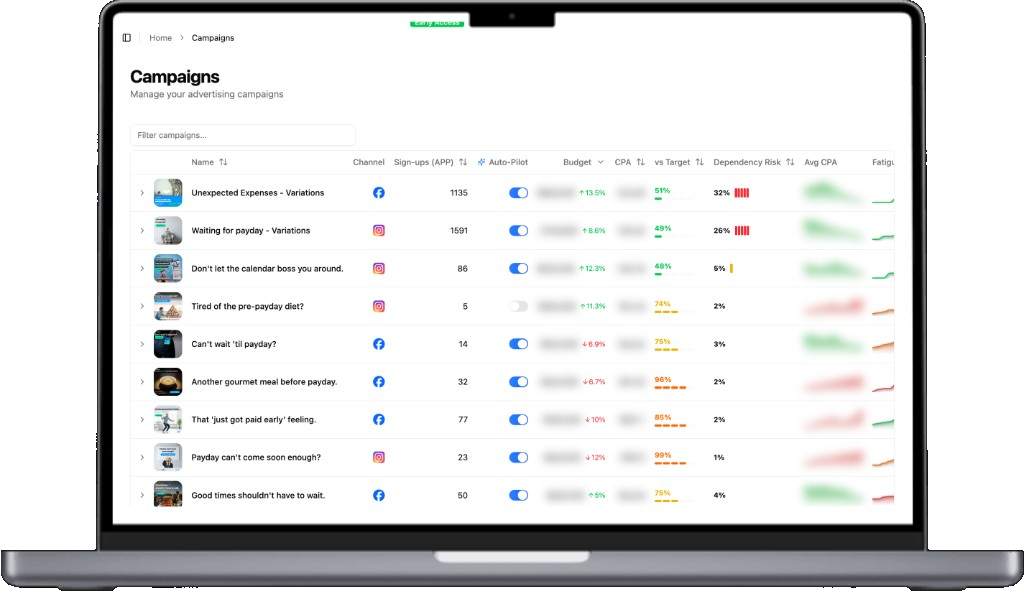

A central consideration in Uplane's design is compatibility with enterprise requirements. This includes integration with existing systems such as CRM and CDP platforms, ad networks, and content management tools, as well as strict adherence to enterprise-grade data security and access control standards. Additionally, Uplane is one of the few solutions that can guarantee 100% brand compliance and ensures that marketing teams remain in full control at any point in time.
In regulated environments, additional functionality is used to align marketing workflows with approval processes and compliance requirements. This includes working with predefined content elements and ensuring that outputs remain within approved boundaries and existing approval workflows, allowing teams to introduce more personalization, testing and automation without bypassing existing controls.
In line with the principles outlined in this playbook, Uplane is typically not just deployed as a standalone tool. Beyond the technology layer, Uplane acts as a strategic partner that supports organizations in structuring workflows, building internal capabilities, and progressing through the four stages of AI adoption. The focus is on enabling teams to move from initial experimentation toward more systematic, scalable approaches and to capture the full value of AI over time.
Throughout this publication, you have read about data points and case examples based on our work with enterprise clients. On average, large organizations using Uplane typically experience
uplift in ROAS
increase in conversion rates
reduction in asset production spend
...all within the first three months of deployment.
We are committed to supporting our clients throughout this journey, and are grateful to share some of their perspectives:
"With Uplane, we're moving from manual campaign execution to intelligent, AI-driven automation. That's exactly the shift a company like Deutsche Bahn needs to stay ahead."


"We switched from a top-tier New York CPG marketing agency to Uplane, and within 2 months our ROAS improved by 60%. More creatives, better landing pages, faster learnings. It's a different league."

"At Enpal, we scaled to thousands of employees and billion-dollar revenue. If Uplane with its AI-first approach had existed back then, we would have scaled our marketing 10x faster. What they have built is a game changer."


"Uplane creates and tests over 500 ads for us every month. That's how we consistently find new top performers. They doubled our new customers per day in just 6 weeks and delivered the best Cost per Acquisition we've ever had."
uplane.com
© Uplane, Inc. All rights reserved.